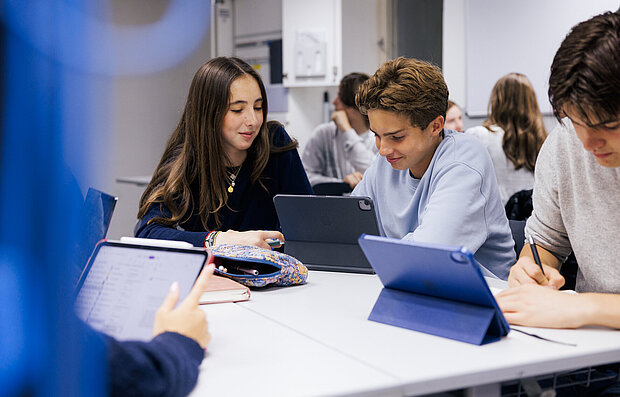
The way we search for information has changed rapidly in recent years. For many young people, TikTok, YouTube, and ChatGPT have long been their first ports of call when it comes to homework, health tips, or the news. They can find an answer there quickly.
But how reliable is that information?
This is precisely where schools face a key challenge: Children and teens need not only access to information, but also the ability to understand it, question it, and put it into context.
Where Young People Get Their Information
- 42% of 16- to 30-year-olds in Europe get most of their information from social media (Euronews, 2025)
- 25% of U.S. teens use ChatGPT for school assignments—twice as many as in 2023 (Pew Research, 2025)
- 90% of popular TikTok videos on health topics are not created by experts (La Trobe University, 2024)
The trend is clear: speed trumps accuracy. This makes it increasingly difficult for students to distinguish between reliable information and misinformation.
The Downside of Info-Fast Food
- Misinformation: From nutrition to politics, misinformation is spreading rapidly.
- Mental health: Constant comparison and screen time are taking an increasing toll on young people.
- Lost research skills: Those who rely entirely on AI and social media practice less how to search, compare, and verify information on their own.
-
What Schools Must Do
To ensure that young people can handle information safely, creatively, and thoughtfully in the future, three things are needed:
- Media and AI literacy as a required course, not just a project week.
- Practical workflows that demonstrate how AI can be used effectively.
-
- A culture of skepticism that encourages children to ask questions and draw their own conclusions.
How Phorms Education Is Taking This Approach
At Phorms, we view digital education as a cornerstone.
Here are a few examples:
- Media concepts and awards for the “Digital School”: Our campuses meet mandatory standards for digital education.
- Bilingual project work: Research in two languages promotes diversity and critical evaluation of sources.
- AI Labs & Prompt Workshops: In our schools, students engage creatively with AI—from storytelling to data analysis.
- “Question-Everything” culture: Debates, source traffic lights, and journalistic methods strengthen critical thinking.
- Parent Academy: Discussions and webinars on social media, AI, and parenting in the digital age.
- Extracurricular Activities, Camps, and Clubs: Spaces where children can express their creativity beyond the screen.
-
The goal: Our students use digital tools confidently, but they don’t rely on them blindly.
What skills must schools teach by 2026 to ensure that TikTok and AI make our children not just faster, but truly smarter?