All Blog Posts

Awarded the special prize for energy at "Jugend forscht": Interview with students from Phorms Frankfurt

20.04.2026
  • Frankfurt

An excellent idea - in the truest sense of the word:
Students from Phorms Frankfurt impressed the judges at the Rhine-Main-East regional competition of "Jugend forscht" with their project for generating energy from compost.


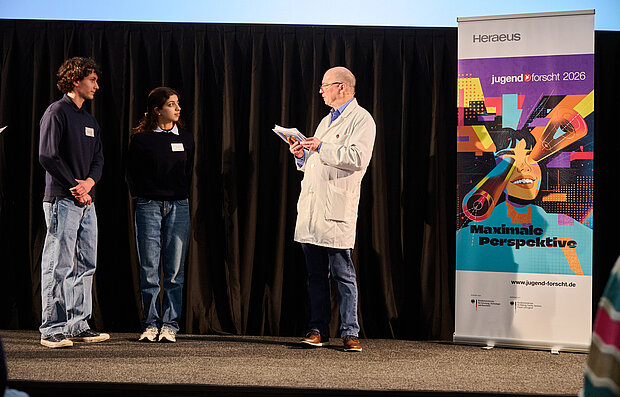
Two of the youngsters, Dana Dalal and Jack Parameswaran, qualified for the state competition on March 18 and 19 in Darmstadt. Although they did not quite manage to win, their commitment and research achievements were still recognized: the duo received the special energy prize for their project, awarded by the Federal Ministry for Economic Affairs and Energy.
 

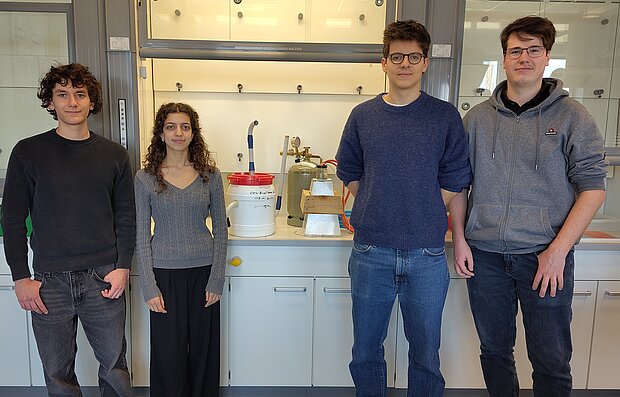
In the interview, Dana Dalal, Fineas Kirchner, Jack Parameswaran and Raphael Theil, explain why environmental protection plays an important role for them, what challenges they had to overcome on their way to the national competition and why they always stuck with it in the end.
 

We are curious: How did you come up with the idea of generating energy from compost?

We wanted to make a contribution to environmental protection, as the topic is very close to our hearts. That's why we looked into which environmental problems are currently particularly pressing. We came across methane emissions, for example from landfill sites and organic waste.

This gave rise to the idea of using methane more efficiently, converting it into energy for private use and thus reducing the environmental impact. It was also important for us to choose a topic that is relevant to everyday life and affects many households. As compost garbage cans are widely used in Germany, we found the approach exciting.
 

You researched your idea over a period of almost three years, supported by Audrey Schollier, a physics and chemistry teacher. What were the biggest challenges during this time?

One of the biggest challenges was putting our theoretical ideas into practice. Especially when building and testing our system, we realized how much time it takes and that setbacks are a natural part of the process. What's more, new topics kept cropping up during our research, which we also had to familiarize ourselves with.
Were there moments when you almost gave up?

Yes, there were. But when there were difficulties, we always asked ourselves: How can we approach the problem differently? What can we change to make it work? That helped us to keep going.

When we had a breakthrough after a challenging phase, it always motivated us again. Mrs Schollier's support was also very important to us, both professionally and personally. We couldn't have done it all without her.
 

What did you take away from the project, both professionally and personally?

Professionally, we learned a lot about how scientific work works: how to plan experiments sensibly, document results and formulate written work in an understandable way.

On a personal level, we learned a lot about teamwork in particular - allocating tasks sensibly, setting priorities and dividing work fairly. We also learned how to deal with fixed deadlines. Overall, the project was a very valuable experience for us.
 

What was it like presenting your results to a jury at the "Jugend forscht" regional competition?

Of course we were nervous beforehand, but the jury interview was surprisingly relaxed and pleasant. The judges listened attentively and asked interesting questions. Up until the day before, it was still unclear whether our composter system would work at all.

It wasn't until the evening before the competition that we managed to assemble the entire system and test it successfully. A real sense of achievement. The fact that it worked out at the last minute made us all the happier. This sense of achievement gave us the confidence we needed to go into the competition with a good feeling.
 

It wasn't quite enough to win the state final, but your idea was awarded the special prize for energy. What does this award mean to you?

We are of course delighted and feel honored. There were many strong projects in the competition. It's even nicer to see that the work we've done over the last few years has paid off. We would be delighted if our idea was taken up again in the future and developed further, perhaps even in another Jugend-forscht project. For now, our focus is on the Abitur.
 

Thank you very much for the interview. We wish you every success for the upcoming Abitur exams and are very excited to see where your path will take you afterwards!

The four student researchers: Jack Parameswaran, Dana Dalal, Fineas Kirchner and Raphael Theil.

Jack Parameswaran and Dana Dalal at the regional competition in Hanau.

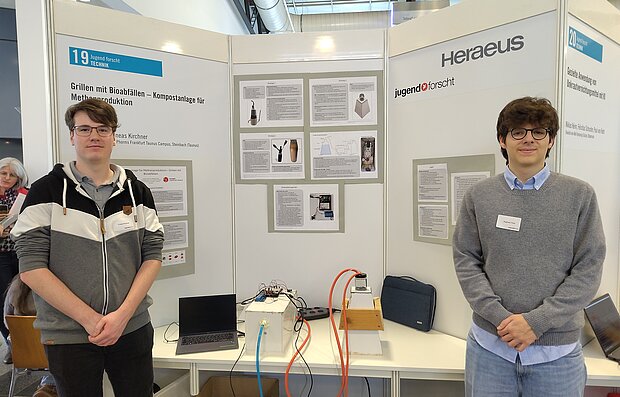
Fineas Kirchner and Raphael Theil with their prototype for methane extraction.