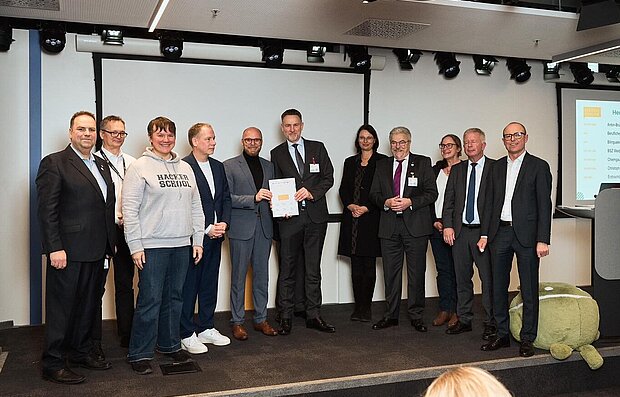
Our school in Munich was also awarded the title “Digital School”—a milestone in our school’s development!
- What criteria had to be met?
The list of criteria for this award is divided into five areas, which were developed by experts and researchers based on the KMK’s strategy for digital education.
-
- Pedagogy & Learning Cultures
- Teacher Training
- Regional Networking
- Concept and Sustainability
- Technology and Equipment
- How do you integrate digital tools and technologies into everyday school life to enrich instruction? Our bilingual campus relies on a consistent 1:1 laptop program for grades 5 through 12. Every student uses their own laptop as an everyday tool in class. Every classroom is equipped with a SMART display, and the use of platforms such as Microsoft Teams, OneNote, and other digital tools is firmly integrated into instruction. In addition, elective courses such as robotics, 3D animation, and Python programming allow students to explore digital technologies beyond the regular curriculum. This prepares them for a digital future.
- How is students’ media literacy fostered, particularly with regard to the critical and responsible use of digital media? For us, fostering media literacy begins as early as 5th grade in the “Learning to Learn” course, where students acquire basic digital skills such as internet research, password security, and how to use platforms like MS Teams. Starting in 6th grade, we apply the principles of “digital citizenship” to address topics such as data protection, cyberbullying, and media literacy. The goal is to empower our students to critically evaluate information, use digital content responsibly, and consciously reflect on their own digital footprint.
- What are the next steps?
AI is a global game-changer, and we must prepare our students for this as well. Many of our colleagues are already experimenting with AI applications to prepare lessons, and some are already using them routinely—as are our students. The possibilities and limitations of AI applications are therefore critically examined in the classroom. Our task for the near future is to expand on this while keeping an eye on the ongoing development of this technology.
With an Educational Technology Coordinator and our own in-house IT department, supported by the network headquarters in Berlin, we are ideally positioned to implement our educational concept—and this was recognized with the award. We are very pleased about this! Next Stop: The Future