This question is on the minds of parents and teachers alike.
AI tools have long been part of students’ everyday lives, whether in the classroom or in their personal lives.
Schools are thus faced with the challenge of familiarizing young people with these tools while simultaneously fostering their own thinking, critical analysis, discussions, and engagement with different perspectives.
German Class with ChatGPT?
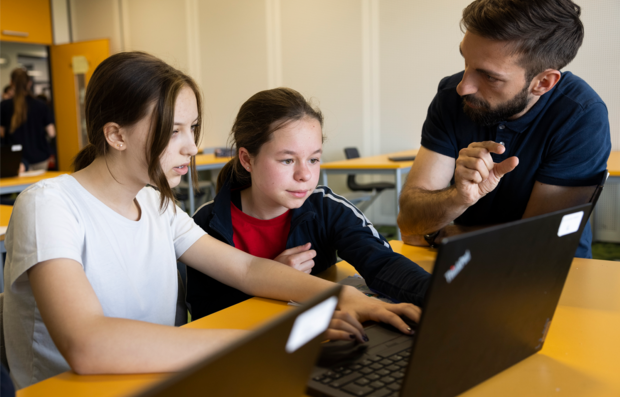
Nikola Grgic is a teacher and a member of the leadership team at the Josef-Schwarz-Schule, where he also focuses on digital processes and topics related to the future. He describes how he uses AI in the classroom, for example:
“In our 8th-grade German class, we discussed the topic of arguing and debating. Over the course of the unit, the students were supposed to learn how to write a complete argumentative essay
In this unit, we worked on a meta-level and asked: Should ChatGPT be allowed in the classroom?
We tackled this task using ChatGPT. But that was only possible after the students had mastered the basics. They needed to know what an analytical essay is, how it’s structured, how arguments work, and how to write a coherent text.
Then the students had the LLM generate the texts, revised them using their own knowledge, and, so to speak, put the AI to the test. At the end, we reflected: What can AI do? And where does it still have problems?”
That’s exactly where the real learning moment lies: The students analyzed the texts, examined arguments, identified weaknesses, revised them, and discussed them—and in doing so, learned that a result isn’t automatically good just because it was available quickly.
Experiences of frustration are also part of the process.
Through setbacks or criticism, children and teenagers learn to grow when they realize: I can persevere, develop an idea further, and overcome a challenge, even if the first attempt isn’t perfect yet.
Nikola Grgic describes this point very clearly: If students simply enter a task and accept the finished result, they miss out on the actual cognitive and emotional engagement with the topic. That is why people must remain actively involved in the process.
Future Prospects
Looking ahead, many scenarios are conceivable. For example, there is the possibility that students will learn even more independently in the future with the help of AI: structuring lesson materials, preparing for tests, generating practice questions, and receiving feedback.
This is an exciting ideal, but it, too, requires guidance.
So the question remains:
How can schools successfully familiarize children and adolescents with AI without depriving them of the valuable detours of learning?
At the Josef-Schwarz-Schule, the answer begins with concrete classroom situations, honest reflection, and a willingness to continue learning together.